We Didn't Have Bad Bunny Back Then
This essay offers a personal and cultural analysis of Bad Bunny’s Super Bowl halftime show, examining its imagery, music, and political symbolism through a Puerto Rican lens. Moving from a formative experience of linguistic discrimination in Boston to a scene-by-scene reading of the performance, the piece explores Puerto Rican history, colonialism, migration, diaspora life in New York, Hurricane Maria, and the ongoing struggle over land, culture, and identity. Whether or not one enjoys reggaetón or Bad Bunny, the halftime show is framed as a significant moment of Latino visibility and resistance at a time when Spanish speakers and Latino communities in the United States face increased criminalization, harassment, and exclusion.
FRANK'S BRAIN
Franklin López
2/9/20263 min read
In 1988, I went to Boston to check out where I might go to college.
I was a senior in high school. It was late. Cold. I was staying with some Puerto Rican friends who lived near Boston College. We were outside waiting for the train — the T, as Bostonians insist on calling it — and we’d had a few drinks. We were laughing, talking shit, speaking Spanish.
And then three big white guys walked up to us.
One of them told us we shouldn’t be speaking Spanish because one of his friends was “really volatile.” I remember asking what that meant, and one of them stepped right up into my face and said, “Do you want to find out?”
That was the beginning of my education.
Up until that point, I thought I was white. I had been raised that way. I had been taught that Puerto Ricans are American citizens, that we belong, that we’re part of this country. Boston — and later college — disabused me of that pretty quickly. I learned that not only was I not white, but that no matter what my passport said, I would never be fully accepted as American.
It was a hard lesson. And back then, we didn’t have Bad Bunny.
Fast-forward to the Super Bowl halftime show.
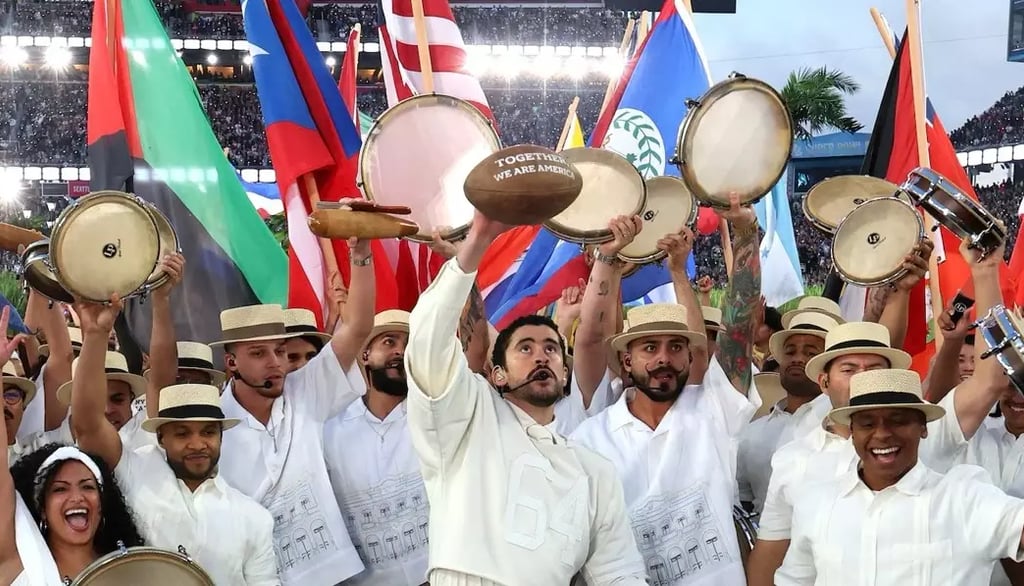
What Bad Bunny did on that stage wasn’t just a performance. It was a cultural essay. A visual argument. A reclamation project.
From the very first frame, we were in Puerto Rico — unmistakably. Murals. Dominoes. Piraguas. Sugarcane fields. The jíbaro. The pava hat. The coquí. Casitas made of cement with Miami windows that look exactly like my grandmother’s house. These weren’t generic “Latin vibes.” They were specific. Intimate. Lived-in.
Sugarcane wasn’t there because it’s pretty. It was there because it tells the truth: about land theft, about monoculture imposed by empire, about labor that fed markets elsewhere while exhausting people and soil at home. Dominoes weren’t there as decoration. They were there because Puerto Rican life is social, loud, collective — because people argue, laugh, talk shit, and stay connected through games that look simple until you realize how strategic they are.
We saw the diaspora too. New York barbershops and bodegas. Pawn shops. Tacos from Los Angeles. Not because Puerto Rican culture is confused, but because migration collides cultures and creates new ones. Puerto Rican identity doesn’t stay frozen on the island — it moves, adapts, survives.
We saw joy. Coco frío. Plena. Salsa. Dancing. Weddings. Love. Music that didn’t come from comfort but from people who made something beautiful anyway.
And we saw pain.
Electrical poles collapsing — a direct memory of Hurricane Maria, when the grid failed not just because of a storm, but because of decades of neglect and corruption. People without power for months. Hospitals scrambling. Elderly people dying. This wasn’t a natural disaster alone. It was political abandonment.
We saw Hawaii invoked as a warning, not a metaphor. A reminder that colonization doesn’t end — it just changes tactics. Land grabs. Water theft. Real estate speculation. Tax shelters for the rich. Displacement for everyone else. What happened there can happen — and is happening — in Puerto Rico.
And then there was the flag.
Not just any flag. A Puerto Rican flag with a lighter blue — a quiet signal associated with the independence movement. Not shouted. Not explained. Just carried. If you know, you know.
This whole performance walked a careful line between celebration and critique, pride and contradiction. I had my issues with it. I still do. Some imagery leaned into machismo in ways that felt tired and harmful, especially in a culture where women already carry the cost of that bullshit. And yeah — the irony is that the song playing in that moment was “Yo Perreo Sola,” a song explicitly about women’s autonomy and consent. That tension is real. Progress is uneven. Liberation is messy.
But nuance doesn’t cancel impact.
Whether you like Bad Bunny or not — I don’t consider myself his biggest fan. Whether you like reggaetón or not — it’s not my favorite genre either — none of that actually matters.
What matters is this: for Puerto Ricans, and for Latinos more broadly, this moment lifted spirits.
We are living in a time when people are harassed, detained, and criminalized for speaking Spanish. When accents are treated like evidence. When being Latino in the United States is framed as suspicious, illegal, or disposable. When people are told — explicitly and implicitly — that they don’t belong.
So to see our language, our music, our history, our contradictions, and our joy placed unapologetically on the biggest stage in the world matters.
It matters to the kid standing on a cold platform somewhere, speaking Spanish with friends and being told to shut up or else.
It matters because representation isn’t about validation from the powerful — it’s about recognition among ourselves.
Back in 1988, we didn’t have Bad Bunny.
Now we do.
Amplifier Films
Amplifying voices for revolutionary change through film.
Amplifier Films in your inbox
Your dollars keeps us rolling and our coverage independent
CONNECT